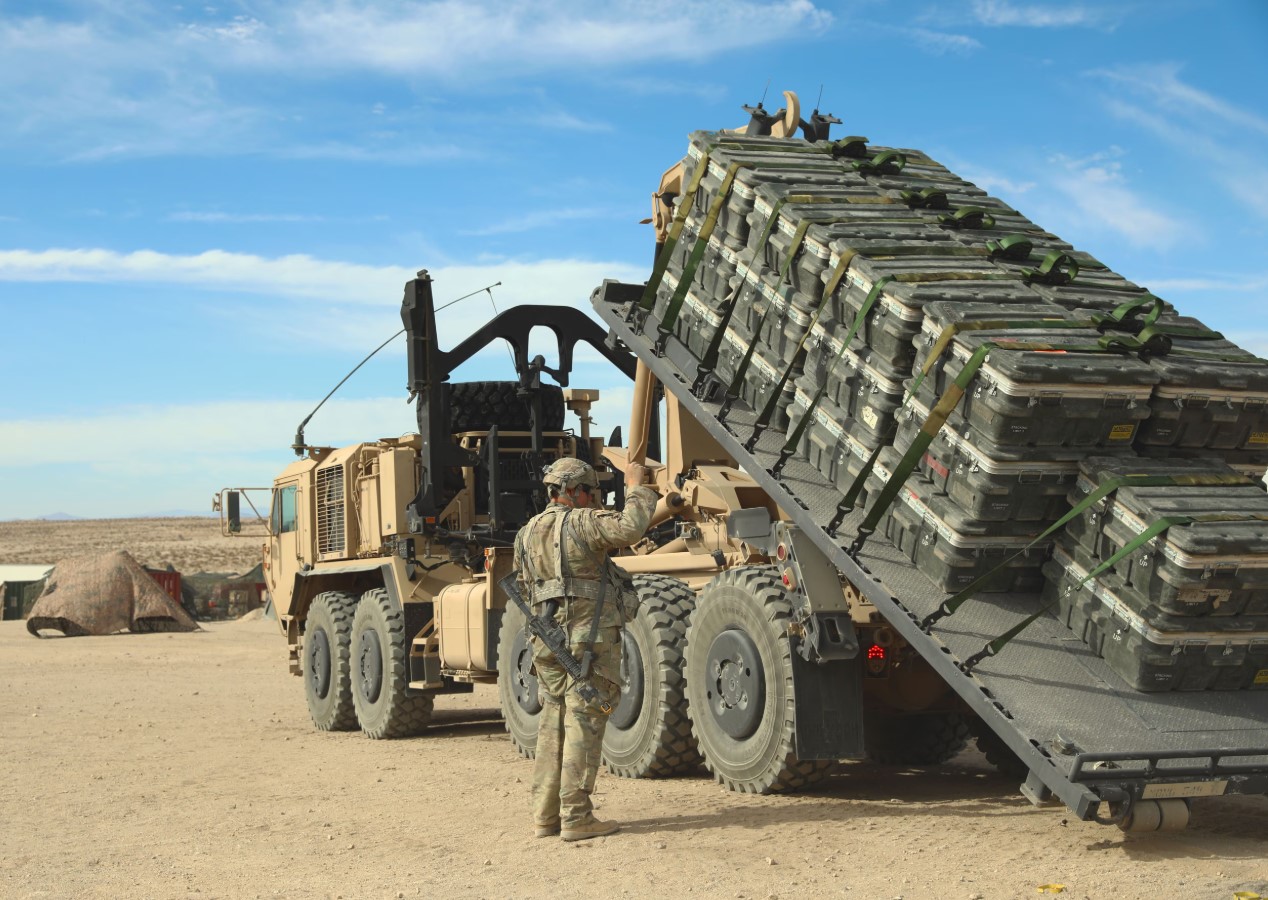

For much of modern military history, attention has focused on weapons systems, troop strength, technological superiority, and battlefield tactics. Yet recent conflicts have highlighted a less visible but equally decisive factor: the defense supply chain. The ability to manufacture, transport, maintain, and replenish military equipment has become one of the most important determinants of military power. In an era of strategic competition, military logistics is no longer merely a support function. It has become a strategic weapon in its own right.
The war in Ukraine, growing tensions between the United States and China, disruptions caused by the COVID-19 pandemic, and increasing concerns over critical materials have exposed vulnerabilities within global defense supply chains. Governments are now recognizing that military readiness depends not only on advanced weapons but also on the industrial ecosystems that sustain them. The nation that can produce, repair, transport, and replenish military capabilities at scale may possess a decisive advantage in future conflicts.
As a result, defense supply chain resilience has become a central pillar of national security strategy across NATO, the Indo-Pacific, and other regions facing heightened geopolitical uncertainty.
The Return of Industrial Warfare
The post-Cold War era encouraged many governments to prioritize efficiency, cost reduction, and globalization. Defense industries adopted just-in-time manufacturing practices, streamlined inventories, and increasingly international supply networks. While these approaches improved efficiency during peacetime, they often reduced resilience during crises.
The conflict in Ukraine demonstrated the limits of this model. High-intensity warfare consumes enormous quantities of ammunition, missiles, spare parts, and military equipment. Artillery shells, precision-guided munitions, armored vehicle components, and air defense interceptors are expended far more rapidly than many planners anticipated.
This reality has revived interest in industrial warfare. Military power is no longer measured solely by the number of platforms a nation possesses. It also depends on the capacity to replace losses, sustain operations, and expand production during prolonged conflict.
The lesson is clear: industrial capacity has returned as a strategic factor in great-power competition.
Military Logistics as a Strategic Capability
Military logistics encompasses far more than transportation. It includes procurement, warehousing, maintenance, repair, supply management, fuel distribution, spare parts availability, and infrastructure support. Together, these functions ensure that military forces remain operational.
History repeatedly demonstrates that logistics often determines the outcome of military campaigns. Armies can only fight if they are supplied. Aircraft can only fly if maintenance systems function effectively. Naval forces require fuel, spare parts, and access to secure ports. Even the most sophisticated weapon systems become ineffective if supply chains fail.
In contemporary warfare, logistics has become increasingly complex. Advanced military systems rely on global networks of suppliers, specialized manufacturing facilities, and highly technical components. This complexity creates opportunities but also vulnerabilities.
Adversaries increasingly recognize that disrupting logistics networks may be more effective than directly attacking military forces. Cyberattacks, economic coercion, sanctions, transportation disruptions, and supply chain interference can weaken military readiness without firing a shot.
The Critical Minerals Challenge
One of the most significant supply chain concerns involves critical minerals and rare earth elements. Modern defense technologies depend heavily on materials such as lithium, cobalt, nickel, graphite, and rare earth metals. These resources are essential for precision-guided weapons, advanced sensors, batteries, radar systems, satellites, and electronic warfare equipment.
The concentration of critical mineral processing in a limited number of countries has raised strategic concerns among Western governments. Dependence on foreign suppliers creates potential vulnerabilities during geopolitical crises.
For defense planners, access to critical materials is no longer simply an economic issue. It has become a national security priority. Governments are increasingly investing in domestic production, alternative supply sources, recycling initiatives, and strategic stockpiles to reduce dependence on potentially unreliable suppliers.
The competition for critical resources is therefore becoming an increasingly important dimension of global defense strategy.
The Munitions Production Challenge
The Ukraine conflict revealed another critical issue: the difficulty of rapidly expanding munitions production. Many Western defense industries were optimized for relatively low production volumes during peacetime. Sustained high-intensity conflict requires significantly greater output.
Artillery ammunition has become a particularly important example. The rate at which munitions have been consumed on the battlefield has exceeded pre-war production capacities in many countries. Similar challenges exist for missiles, air defense interceptors, and precision-guided weapons.
As a result, governments across NATO are investing heavily in expanding manufacturing capacity. New production lines, long-term contracts, workforce development programs, and public-private partnerships are being used to increase output.
These investments reflect a broader recognition that production capacity itself is a strategic asset. The ability to sustain military operations over months or years may prove more important than possessing large stockpiles at the outset of a conflict.
China and the Supply Chain Dimension of Strategic Competition
The global defense supply chain cannot be discussed without considering China. Beijing occupies a central position in numerous industrial sectors, including electronics, batteries, advanced manufacturing, and critical mineral processing.
This position creates both opportunities and risks. Global industries benefit from China’s manufacturing scale and efficiency. At the same time, dependence on Chinese supply chains has raised concerns among governments seeking greater strategic autonomy.
The United States and its allies are increasingly pursuing supply chain diversification strategies. These include reshoring manufacturing, nearshoring production to trusted partners, and developing alternative supply networks.
For defense industries, reducing dependence on potential strategic competitors has become a priority. The objective is not complete economic separation but greater resilience in the event of geopolitical disruption.
The NATO Perspective
NATO’s ability to deter and defend depends heavily on logistics. The alliance’s multinational structure requires extensive coordination among member states, defense industries, transportation networks, and military organizations.
The reinforcement of NATO’s eastern flank has highlighted the importance of military mobility. Forces must be able to move rapidly across borders, access infrastructure, and receive sustained logistical support. Supply chains must function under both peacetime and wartime conditions.
Alliance planners increasingly recognize that logistics networks themselves may become targets during future conflicts. Protecting transportation infrastructure, ports, rail systems, communications networks, and industrial facilities is therefore becoming an essential element of collective defense.
The concept of resilience now extends beyond military units to include the broader industrial and logistical systems that support them.
Technology and the Future Supply Chain
Emerging technologies are transforming defense logistics. Artificial intelligence, predictive analytics, digital twins, autonomous transportation systems, and advanced data management tools are improving supply chain visibility and efficiency.
AI can help forecast demand, identify bottlenecks, optimize inventory management, and support maintenance planning. Autonomous vehicles and drones may eventually play a greater role in military resupply operations, particularly in contested environments.
Digitalization also enhances transparency. Military organizations increasingly seek real-time awareness of inventory levels, transportation status, production schedules, and supplier performance.
However, greater connectivity introduces new cybersecurity risks. Supply chain networks themselves can become targets for cyberattacks. Protecting digital infrastructure is therefore becoming as important as protecting physical assets.
Strategic Autonomy and Defense Resilience
Across Europe, North America, and the Indo-Pacific, governments are increasingly linking supply chain resilience to strategic autonomy. The objective is not self-sufficiency in every sector but the ability to sustain critical capabilities during crises.
Strategic autonomy requires reliable access to key technologies, industrial capacity, skilled labor, energy resources, and transportation infrastructure. Defense planners are increasingly evaluating supply chains through a national security lens rather than purely economic considerations.
This shift reflects a broader understanding that economic security and military security are becoming increasingly interconnected. Industrial resilience, technological sovereignty, and logistical flexibility are now essential components of national power.
The Strategic Weapon of the Twenty-First Century
The traditional image of military power often focuses on tanks, warships, aircraft, and missiles. Yet these capabilities depend on a much larger ecosystem. Factories must produce components. Suppliers must deliver materials. Transportation networks must function. Maintenance systems must remain operational.
In a prolonged conflict, the ability to sustain these processes may determine success or failure. Military logistics therefore represents more than support activity; it is a strategic capability that shapes operational effectiveness, deterrence credibility, and long-term resilience.
Adversaries increasingly understand this reality. Supply chains have become targets for economic pressure, cyber operations, industrial espionage, and strategic competition. Defending them is now a core national security requirement.
Conclusion
The global defense supply chain has emerged as one of the most important battlegrounds of modern strategic competition. The lessons of recent conflicts demonstrate that military power depends not only on weapons but also on the industrial and logistical systems that sustain them.
Governments are responding by investing in defense manufacturing, critical minerals security, munitions production, supply chain diversification, and logistical resilience. These efforts reflect a growing recognition that industrial capacity and military readiness are inseparable.
In the twenty-first century, military logistics is no longer a background function. It has become a strategic weapon that influences deterrence, operational effectiveness, and national security. The nations that can build resilient, adaptable, and secure defense supply chains will be better positioned to compete and prevail in an increasingly uncertain world.
Key Takeaways
- Defense supply chains have become a strategic element of military power and national security.
- The Ukraine conflict exposed vulnerabilities in munitions production and industrial capacity.
- Critical minerals and rare earth elements are increasingly important for defense technologies.
- NATO and allied nations are investing in supply chain resilience, logistics, and defense manufacturing.
- Future military effectiveness will depend as much on industrial capacity and sustainment as on advanced weapon systems.
Leave a Comment