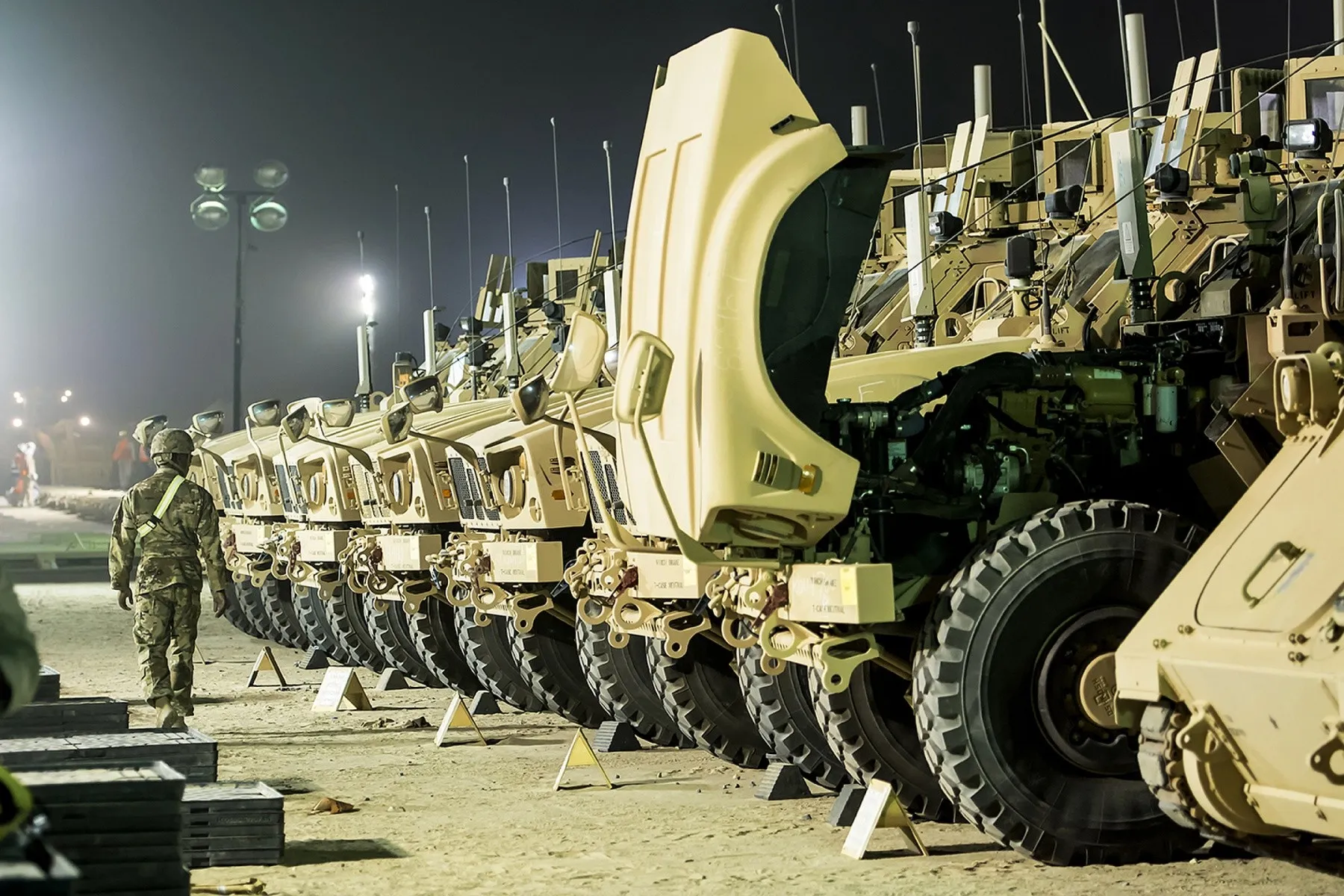

For decades, military logistics operated in the background of defence planning essential but rarely headline-worthy. That era is over. In 2026, the global military logistics and infrastructure market has become one of the most strategically significant, fastest-growing segments of the entire defence industry. Geopolitical competition, hard lessons from the war in Ukraine, and the accelerating integration of artificial intelligence are reshaping how nations plan, fund, and execute the movement of forces and materiel across the globe.
A Market Expanding at Scale
The numbers reflect a fundamental shift in defence priorities. According to current market analysis, the global defence logistics sector has grown from approximately USD 415 billion in 2025 to an estimated USD 455 billion in 2026 a growth rate of nearly ten percent in a single year. Projections indicate the market will reach between USD 600 billion and USD 648 billion by 2030, sustained by a compound annual growth rate of around nine percent.
The broader military infrastructure and logistics segment, encompassing military bases, ports, airfields, weapons storage facilities, and communications infrastructure adds further weight to these figures. The global military bases segment alone is projected to reach USD 234 billion by 2026.
North America remains the dominant region, accounting for approximately 36 percent of global market growth. The United States is by far the largest single national market, with estimates placing the American defence logistics sector at over USD 52 billion in 2026 representing nearly half of global demand. The U.S. Department of Defense allocated approximately USD 886 billion in fiscal year 2025, a five percent increase from the previous year, a significant portion of which flows directly into logistics modernisation and sustainment infrastructure.
Europe and the Indo-Pacific are closing the gap rapidly, driven by escalating threat perceptions and urgent modernisation programmes.
What Is Driving This Growth?
Geopolitical Pressure and Sustained Conflict
The war in Ukraine exposed critical weaknesses in Western logistics infrastructure from ammunition production shortfalls to fragile supply chains that had not been stress-tested under sustained high-intensity warfare. Military planners across NATO drew immediate conclusions: the ability to generate, sustain, and resupply forces at scale is not a secondary concern but a primary determinant of strategic success.
Global military expenditure reached a record USD 2.443 trillion in 2023, with a year-on-year increase of 6.8 percent the steepest rise since 2009. That momentum has continued into 2025 and 2026, with the NATO alliance recently committing to an ambitious five percent of GDP defence spending target. A substantial share of this expanded investment is directed at logistics capabilities, from pre-positioned equipment to hardened storage facilities and interoperable transport networks.
The Rise of Contested Logistics
Perhaps the most consequential concept reshaping the defence logistics market today is the doctrine of contested logistics the recognition that military supply chains, transportation nodes, and sustainment infrastructure are themselves targets in modern conflict.
The U.S. Pentagon has formally designated contested logistics as one of its six Critical Technology Areas. Pentagon Chief Technology Officer Emil Michael has described it as a challenge that extends across the entire operational spectrum: „It’s not just the systems that are forward or the exquisite systems. It is everything from the interconnected software, it is transportation nodes, its logistics hubs, it’s fuel, it’s ports, it’s the supply chain all the way down to the critical minerals.“
This recognition is driving investment in redundancy, distributed basing, hardened infrastructure, and cyber-secure supply chains. In the Indo-Pacific in particular, distributed logistical networks and forward-deployed supply points are becoming a central feature of U.S. and allied military planning, directly responding to Chinese anti-access and area-denial capabilities.
Technology as the Decisive Variable
The most significant transformation underway in military logistics is technological. Three areas are reshaping the sector at pace.
Artificial Intelligence and Predictive Analytics
AI is moving from peripheral tool to operational backbone in defence supply chains. The Defence Logistics Agency (DLA) in the United States has reported a 25 percent increase in supply chain efficiency through the implementation of predictive analytics. The Joint Logistics Command has cited a 40 percent improvement in mission readiness levels through the integration of AI-powered logistics management systems.
AI applications in military logistics now span demand forecasting for ammunition, fuel, and spare parts; predictive maintenance of vehicles and platforms; real-time inventory management; and optimisation of transportation routing under dynamic threat conditions. In Ukraine, AI-driven platforms are already analysing sensor data to generate real-time logistical predictions under active combat conditions.
NATO is investing in AI integration across the alliance’s logistics architecture. Atlantic Council analysis describes AI’s role as fundamental: supporting predictive maintenance of critical stockpiles, forecasting demand across joint formations, and anticipating bottlenecks in transportation networks before they become operational crises.
Digital Sustainment Platforms and IoT Integration
Digital sustainment platforms integrating IoT sensors, cloud infrastructure, and connected assets are transforming operational visibility. Commanders can now access real-time information on equipment status, inventory levels, transportation assets, and maintenance requirements across distributed theatres of operation.
The concept of digital twins virtual replicas of physical logistics systems that enable predictive modelling is gaining traction in defence sustainment. These systems allow maintenance teams to simulate component degradation and schedule interventions before failures occur, reducing platform downtime significantly compared to traditional reactive approaches.
Interoperability between national and allied logistics platforms is emerging as both a priority and a challenge. NATO’s digital transformation goals explicitly target the creation of a robust, shared data ecosystem that enables seamless information flow across organisational and national boundaries a capability that remains aspirational in many areas but is advancing rapidly.
Robotics and Autonomous Systems
Autonomous systems are entering the military logistics domain beyond the battlefield. In April 2026, German AI and robotics firm Circus SE won a public procurement contract to deploy a fully autonomous sustainment robot to a Lithuanian Armed Forces base in Vilnius the first deployment of its kind on NATO’s eastern flank. The system integrates AI-driven demand forecasting, waste reduction, and predictive maintenance, reducing personnel burden and increasing operational efficiency at forward bases.
Autonomous mobile robots are increasingly being evaluated for intralogistics tasks at military installations, supply depots, and maintenance facilities. The long-term trajectory points toward significantly reduced human footprint in routine sustainment tasks, freeing personnel for higher-value operational roles.
Infrastructure: The Forgotten Pillar
Military logistics cannot be separated from the physical infrastructure that enables it. Investment in military bases, airports and landing strips, ports and naval facilities, communications systems, and weapons storage is accelerating across NATO, the Indo-Pacific, and the Gulf region.
Modernisation is the dominant theme. Updated bases integrating smart surveillance, automated logistics systems, and infrastructure resilient to both cyber threats and physical attack are becoming essential requirements for contemporary military operations. This modernisation agenda creates substantial opportunities for defence contractors and technology companies with relevant capabilities.
In Europe, NATO’s eastern flank is the focal point. The Baltic states, Poland, Romania, and Finland have accelerated base modernisation and infrastructure investment in direct response to the threat environment following Russia’s invasion of Ukraine. Germany is investing in its role as a transit hub for allied forces moving eastward, including upgrades to rail, road, and airlift infrastructure.
In the Indo-Pacific, the United States has expanded its basing footprint in the Philippines, Japan, and Australia. The AUKUS partnership is driving naval infrastructure investment across the Pacific, while Japan and South Korea are both expanding domestic military logistics capacity.
Key Industry Players and Investment Dynamics
The military logistics market is served by a combination of large prime contractors, specialist logistics firms, and an expanding cohort of technology companies. Lockheed Martin received a USD 3.37 billion contract modification in late 2024 for F-35 logistics support illustrative of the scale at which sustainment contracts now operate. BAE Systems, Northrop Grumman, Raytheon Technologies, and L3Harris are all deepening their logistics technology capabilities.
A growing trend toward performance-based logistics contracts where payment is tied to operational outcomes such as platform availability rates rather than inputs is restructuring the commercial relationship between industry and military customers. This model incentivises efficiency and innovation throughout the supply chain.
Perhaps the most significant strategic shift is the increasing partnership between defence prime contractors and technology companies. AI, blockchain for supply chain transparency, and IoT connectivity are being integrated into military logistics through collaboration between traditional defence firms and software-native companies. The boundary between the technology sector and the defence logistics industry is becoming less distinct by the year.
The Road Ahead
The military logistics market in 2026 is not experiencing a temporary surge driven by a single conflict or budget cycle. It reflects a structural transformation in how nations understand military power. The ability to project, sustain, and protect forces and supply chains under contested conditions has been elevated to the same strategic importance as platform quality, firepower, or cyber capability.
This has fundamental implications for industry, government investment, and alliance planning. Nations that invest now in resilient, technology-enabled logistics infrastructure will hold a decisive advantage in the conflicts and the deterrence competition that lies ahead. Those that do not risk the same lesson the Ukraine war delivered so brutally to Western planners: that a military without the logistical backbone to sustain high-intensity operations is a military that cannot fight.
The global military logistics market, growing toward USD 650 billion by the end of the decade, is a direct expression of that lesson written in procurement budgets rather than ink.
Leave a Comment